

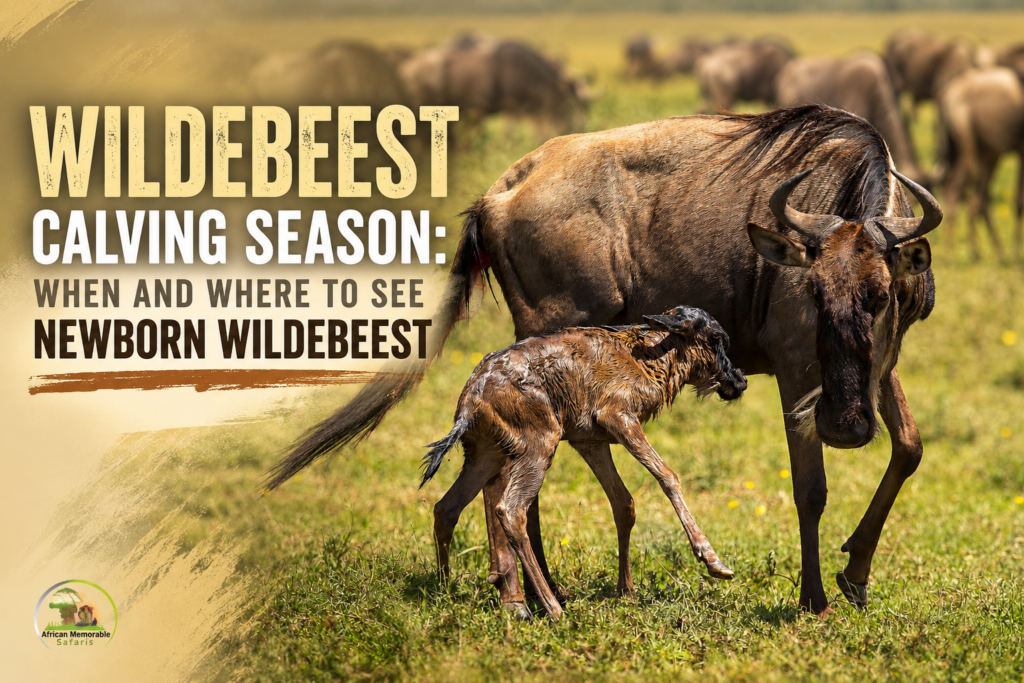
Every year, one of Africa’s most moving wildlife spectacles unfolds quietly across the southern plains of the Serengeti-Mara ecosystem. It isn’t the thunder of a river crossing or the roar of a lion on the hunt; it’s the arrival of new life. During calving season, hundreds of thousands of wildebeest calves are born within a matter of weeks, filling the plains with the wobbly first steps of the next generation of the Great Migration.
If you’re planning a safari built around this event, here’s everything you need to know, including exactly when it happens, where to be, and how it fits into a Kenya-based safari itinerary.
Not sure which Kenya tour package fits? Click, check a suitable itinerary, and talk to an expert for advice.
What Is the Wildebeest Calving Season?
Calving season is the period when the majority of the migratory wildebeest population gives birth, an astonishing, tightly synchronized event that sees up to 8,000 calves born every single day at its peak. Female wildebeest carry their young for roughly 8.5 months, and thanks to a shared biological rhythm across the herd, most births happen within the same narrow window of just a few weeks.
This synchronization isn’t an accident. It’s a survival strategy known as predator swamping: when so many calves arrive at once, predators simply cannot consume them all, giving the majority a chance to survive those critical first vulnerable days.
Remarkably, newborn wildebeest can stand within about 10 minutes of birth and are running alongside the herd within an hour, a necessary adaptation in a landscape thick with lions, hyenas, cheetahs, and leopards waiting for an easy meal.
Read more: Best Time for Kenya Safari & Migration (2026 Complete Guide)
When Is Wildebeest Calving Season?
Wildebeest calving season runs from late January through March, with February widely regarded as the peak month, when calving activity is at its most dramatic and concentrated.
This timing isn’t arbitrary; it lines up precisely with the short rains that green up the southern plains in November and December, producing the nutrient-rich grazing pregnant wildebeest need to sustain the final stage of gestation and the demands of nursing afterward.
Where Does Wildebeest Calving Actually Happen?
This is the detail many travelers get wrong, so it’s worth being precise: while this guide is written for those exploring safaris through Kenya, the wildebeest calving season in the Serengeti, specifically the southern Serengeti plains, the Ndutu area, and parts of the Ngorongoro Conservation Area, is where the vast majority of births take place, not the Maasai Mara itself.
The wildebeest calving season in Tanzania centers on this southern region because of its short, nutrient-dense grasses, flat open terrain (which makes it easier to spot approaching predators), and reliable seasonal rainfall. By contrast, the Maasai Mara in Kenya is where the herds spend the dry season months (roughly July through October) grazing, mating, and preparing for the next leg of their journey, but calving itself unfolds further south, across the border in Tanzania.
Understanding this distinction matters for trip planning: if witnessing the actual births is your top priority, your itinerary needs to include time in the Ndutu/southern Serengeti region during the January–March window, rather than the Maasai Mara alone.
Read more: The Great Wildebeest Migration Has Begun: Complete Guide to Kenya’s 2026 Migration Season
Wildebeest Calving Season Map: How the Migration Connects to Kenya
Here’s a simplified look at how the calving season fits into the broader migration cycle relevant to a Kenya safari itinerary:
- November–December: Short rains fall; herds move south from the Maasai Mara and central Serengeti toward the southern plains
- January–March: Calving season concentrated in Ndutu, southern Serengeti, and the Ngorongoro Conservation Area, peaking in February
- April–June: Herds begin moving north again; this period also overlaps with the wildebeest mating season (the rut), when bulls compete fiercely for mates as the columns migrate through the central and western Serengeti
- July–October: The herds arrive in Kenya’s Maasai Mara, crossing the Mara and Grumeti Rivers along the way. This is the dry-season phase most travelers associate with the migration
- November: The cycle begins again as the short rains pull the herds south
Understanding this full cycle helps explain why “calving season” and “migration season” are often confused; they’re two distinct, equally spectacular phases of the same year-round journey.
Is It Worth Planning a Trip Around the Calving Season?
Absolutely for a very specific kind of traveler. Calving season delivers:
- Unmatched predator action – lions, cheetahs, and hyenas are drawn in huge numbers to the concentration of vulnerable newborns, making this one of the best times of year for predator sightings
- Fewer crowds – compared to the peak river-crossing months (July–October), the calving season falls in what’s technically considered low season, meaning quieter camps and more intimate game viewing, even though it’s an equally dramatic event
- Dramatic, fast-paced action – from birth to first steps to first predator encounters, the pace of life (and death) on the plains during this period is intense and constant
If your safari priority is witnessing new life and predator-prey drama up close, calving season rivals and arguably surpasses the famous river crossings in terms of raw wildlife action.
Planning Your Kenya Safari Around the Migration Calendar
For travelers arranging a Masai Mara safari or broader Kenya safari and tours itinerary, timing is everything. If calving season itself is your priority, your trip needs a Tanzania component (southern Serengeti/Ndutu) during January–March. If you’re aiming to catch the herds in Kenya, the Maasai Mara delivers exceptional game viewing from roughly June through October, including the dramatic river crossings and the tail end of the mating season.
Many travelers choose to combine both witnessing calving season in the southern Serengeti earlier in the year, and returning later to experience the Maasai Mara at the peak of the dry season. A well-planned, private itinerary that tracks the migration’s natural rhythm, rather than locking into one park or one month, is the best way to maximize your chances of witnessing the specific moments that matter most to you.
Whether you’re drawn to the raw drama of calving season, the tension of the mating season rut, or the spectacle of a river crossing, the key is working with a safari operator who understands exactly where the herds are likely to be and can build your private itinerary around it.
Planning a Kenya safari around the Great Migration? Get in touch with African Memorable Safaris to build a private, tailor-made itinerary timed to the exact wildlife experience you want to witness.
FAQ
1. When exactly is wildebeest calving season?
Calving season runs from late January through March, with February widely considered the peak month for births.
2. Where does wildebeest calving actually happen – Serengeti or Maasai Mara?
The vast majority of calving takes place in the southern Serengeti plains and the Ndutu area of Tanzania, not in Kenya’s Maasai Mara. The Mara is where herds spend the dry season (roughly July–October), but the actual births are concentrated further south.
3. How many wildebeest are born during calving season, and how fast do they move?
At its peak, up to 8,000 calves can be born in a single day. Remarkably, a newborn can stand within about 10 minutes of birth and is running alongside the herd within an hour.
4. Is calving season a good time to see predators too?
Yes, the concentration of vulnerable newborns draws large numbers of lions, cheetahs, and hyenas to the area, making calving season one of the best times of year for dramatic predator-prey sightings.
5. Can I combine calving season with a Kenya safari?
Yes, many travelers combine a trip to the southern Serengeti/Ndutu during calving season (January–March) with a later visit to Kenya’s Maasai Mara during the dry season (June–October) to experience both phases of the migration.