

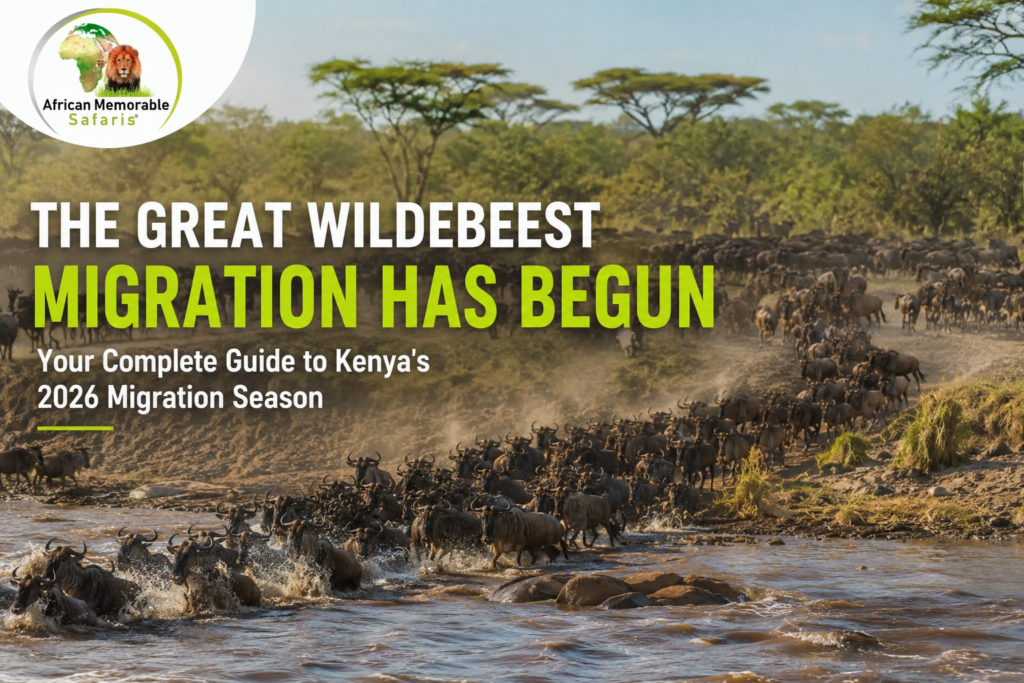
Every July, one of the natural world’s most dramatic events reaches a turning point. The first waves of wildebeest and zebra herds start pushing north out of Tanzania’s Serengeti and across the border into Kenya’s Maasai Mara. For anyone planning Kenya tours and safaris this year, this is the moment the calendar has been building toward, and it’s why July through October is widely regarded as the best window for a Kenya and Tanzania safari.
This guide walks through everything you need to know about the Great Wildebeest Migration: why it happens, the route it follows, its yearly cycle, the risks the herds face along the way, and what it means for your safari planning right now.
What Is the Great Wildebeest Migration?
The African wildebeest migration is the largest overland movement of animals on the planet. Somewhere between 1.3 and 2 million wildebeest, joined by hundreds of thousands of zebras, eland, and gazelle, move in a continuous loop through the Serengeti-Mara ecosystem, chasing rainfall and fresh grazing across the border between Tanzania and Kenya. It isn’t a single event, it’s a year-round cycle, but the phase most travelers picture when they hear “migration” is the one unfolding right now: the herds gathering at the Mara River and beginning their crossings into Kenya.
Why Do Wildebeest Migrate?
Wildebeest migrate for one simple reason: grass and water. Unlike predators, which can survive on stored fat between kills, wildebeest need a constant supply of short, nutrient-rich grass, and that grass only grows where recent rain has fallen. As the rains shift across East Africa through the year, the grazing shifts with them, and the herds guided largely by instinct and the smell of distant rainfall follow.
There’s no single leader driving this decision. Wildebeest have no fixed hierarchy, which is why the “migration” often looks less like one giant herd and more like dozens of smaller groups moving in roughly the same direction, splitting off and rejoining as conditions change. It’s this instinct-driven, decentralized movement repeated by the same population for thousands of years that makes the migration both so reliable in its general pattern and so unpredictable in its exact timing and location year to year.
The Wildebeest Migration Route and Map
The wildebeest migration route forms a rough clockwise loop of around 800 kilometers (500 miles) through the Serengeti-Mara ecosystem, although individual animals often backtrack and cover well over 1,000 kilometers in a single cycle. In broad strokes, the wildebeest migration map looks like this:
- Southern Serengeti and Ndutu plains (Tanzania) — the calving grounds, where the cycle effectively resets
- Central Serengeti and the Western Corridor — the herds move north and west, crossing the Grumeti River
- Northern Serengeti and the Mara River — the herds converge in the Lamai Wedge area, where the border-straddling Mara River crossings take place
- Maasai Mara National Reserve (Kenya) — the herds spend several months grazing across the border before turning back south
Because the exact route depends entirely on where rain has fallen that season, no two years look identical, but the general shape of this loop repeats reliably.
The Wildebeest Migration Cycle, Month by Month
Understanding the wildebeest migration cycle helps make sense of why July is such a pivotal month:
- January–March: The herds are in the southern Serengeti plains and Ndutu area, where the majority of calves are born, as many as 8,000 a day during the peak of calving season.
- April–May: The herds head north and west through the Serengeti’s Western Corridor, crossing the Grumeti River along the way, while mating season also takes place.
- June: The herds continue north, gathering on the northern plains of the Serengeti and beginning to approach the Mara River.
- July–September: This is the peak migration season. The first Mara River crossings begin in July, with the most dramatic crossings typically running through August and into September as herds push into Kenya’s Maasai Mara.
- October: Crossings taper off, and the herds settle into more casual grazing across the Mara.
- November–December: Short rains prompt the herds to begin their journey back south, retracing the loop toward the Serengeti in time for the next calving season.
This is why a Serengeti wildebeest migration safari in April looks completely different from a Maasai Mara migration safari in August, you’re catching the same herds at entirely different chapters of their year-long journey.
Why July Is One of the Best Months to Go
Right now, in July, several things line up at once:
- The long rains have ended, leaving behind fresh green landscapes, clearer skies, and far more comfortable daytime temperatures than the wet season.
- The herds are arriving, meaning wildlife density in the Mara is climbing fast as hundreds of thousands of animals funnel into the reserve.
- Predator activity is high, since large concentrations of grazing animals draw lions, cheetahs, leopards, and hyenas along with them.
- River crossings are beginning, giving early-arriving travelers a chance to witness the dramatic Mara River crossings without the absolute peak-season crowds of August.
For travelers weighing a Kenya and Tanzania safari, this transitional period, when the herds are still crossing into Kenya rather than already settled, can offer some of the most exciting and photogenic game viewing of the year.
Read More: Complete Guide on Kenya Migration Safari 2026
How Many Wildebeest Die During the Migration?
The migration is often described as nature’s greatest wildlife show, but it’s also a genuinely brutal test of survival. Every year, an estimated 250,000 wildebeest and around 30,000 zebras die during the migration cycle. Causes of death include:
- Predation — lions, leopards, cheetahs, hyenas, and wild dogs all trail the herds, picking off the weak, young, or injured
- Drowning and crushing — the Mara and Grumeti River crossings are the single most dangerous stretch of the journey, where panicked animals can drown or be trampled in the crush to cross, and Nile crocodiles wait in the water
- Exhaustion, thirst, and hunger — the sheer distance of the trek, combined with unpredictable rainfall, takes a toll even on animals that avoid predators entirely
Despite these numbers, the herd’s survival strategy works: well over 80% of the animals that begin the migration survive it, and the population has remained broadly stable for decades. Ecologists have also found that the carcasses left behind by drownings play a real role in the health of the Mara River ecosystem, cycling nutrients back into the water that support fish and other aquatic life. In effect, the deaths that make the migration so dramatic to watch are also part of what keeps the wider ecosystem functioning.
Maasai Mara Park Fees During Migration Season
One practical detail worth knowing before you book: park entry fees in the Maasai Mara are seasonal. From July 1 through December 31, which covers the entire migration and river-crossing season, park fees rise to $200 per adult per day, compared to $100 per day during the January–June low season. This higher fee reflects both the peak demand and the reserve’s role in funding conservation and anti-poaching efforts during the busiest months of the year. It’s a cost worth building into your budget early, since accommodation in and around the Mara also tends to book out well in advance for this period.
Compare premium Masai Mara safari itineraries and find the perfect tour for your next trip. Click to explore.
Kenya and Tanzania Safari: Which Side Should You Choose?
Because the migration straddles the border, one of the most common questions travelers ask is whether to base a trip in Kenya’s Maasai Mara or Tanzania’s Serengeti. A few points to weigh:
- Timing matters more than country. The Mara River crossings can be watched from either side, but the herds are only reliably in Kenya’s Maasai Mara for a few months a year, roughly July through October, whereas they spend the majority of the year in Tanzania.
- July–August favors Kenya. As the first herds arrive and begin crossing north, the Maasai Mara side offers front-row access to the action building right now.
- Combining both is entirely possible for travelers with more time, allowing you to follow the herds’ movement across the ecosystem rather than picking a single vantage point.
Kenya Tours and Safaris: Planning Your Migration Trip
If you’re planning Kenya tours and safaris around this year’s migration, a few practical tips:
- Book early. Peak migration season (July–October) is the most in-demand travel window in East Africa, and camps in prime river-crossing locations fill up months in advance.
- Build in flexibility. Rainfall ultimately decides when and where the herds cross, so the most experienced guides plan for a range of possible crossing points rather than a single fixed location.
- Think beyond the crossings. Even outside the exact moment of a river crossing, the sheer volume of wildlife moving through the Mara during migration season makes for exceptional game viewing, from predator action to the sight of hundreds of thousands of animals spread across the plains.
View exclusive Kenya & Tanzania Safari itinerary, inclusions, and pricing. Click to get started.
Quick Wildebeest Migration Facts
- Between 1.3 — 2 million wildebeest take part in the migration each year, alongside hundreds of thousands of zebras and gazelles.
- The full migration loop covers roughly 800 km (500 miles), though individual animals often travel much farther.
- It is considered the largest and longest overland migration of large mammals on Earth.
- Wildebeest have no single leader; the herd moves through collective instinct rather than hierarchy.
- Calving season peaks in February, when up to 8,000 calves can be born in a single day.
- Roughly 250,000 wildebeest and 30,000 zebras die during the migration each year, mostly from predation, drowning, and exhaustion.
- July marks the start of the Mara River crossings into Kenya, with the most dramatic crossings usually running through August and September.
Final Thoughts
The Great Wildebeest Migration is one of the few truly reliable wildlife spectacles left on Earth, not because it happens on a fixed schedule, but because, year after year, the same instinct pulls over a million animals across the same stretch of Africa in search of rain and grass. Right now, with the herds beginning to push into Kenya’s Maasai Mara, this month offers one of the best combinations of good weather, rising animal numbers, and early river-crossing action of the entire migration cycle.
If you’re weighing your options for a migration season safari, the earlier you start planning, the more choice you’ll have in camps, guides, and itineraries during Kenya’s busiest and most rewarding months.
FAQ
1. When is the best time to see the 2026 Great Wildebeest Migration in Kenya?
The best time to see the Great Migration in Masai Mara is between July and October in 2026, when the wildebeest herds have crossed from Tanzania’s Serengeti into Kenya, with the most dramatic Mara River crossings typically peaking in August and September. That said, exact crossing dates cannot be predicted, as arrivals can begin as early as late June and extend into November depending on rainfall patterns.
2. How many animals take part in the migration, and what’s the actual route?
The migration involves over 1.5 million wildebeest, along with zebras and gazelles, moving between Tanzania’s Serengeti and Kenya’s Masai Mara, following the rains for fresh grass. Along the way, wildebeest cross three rivers entering Kenya during the migration: the Sand River first, then the Talek, then the Mara River, with only the Mara River delivering the dramatic leaps and crocodile encounters.
3. What does it cost to visit, and are there entry fee rules to know?
The Masai Mara National Reserve entry fee is $200 per person per day during peak season in 2026, and this fee is valid from 6:00 AM to 6:00 PM on the day of entry — it does not roll over to the next day. On top of park fees, full safari packages (accommodation, meals, guide, transfers) vary widely depending on the level of comfort you choose.